
What Are the Stages of the B2B Buying Process?
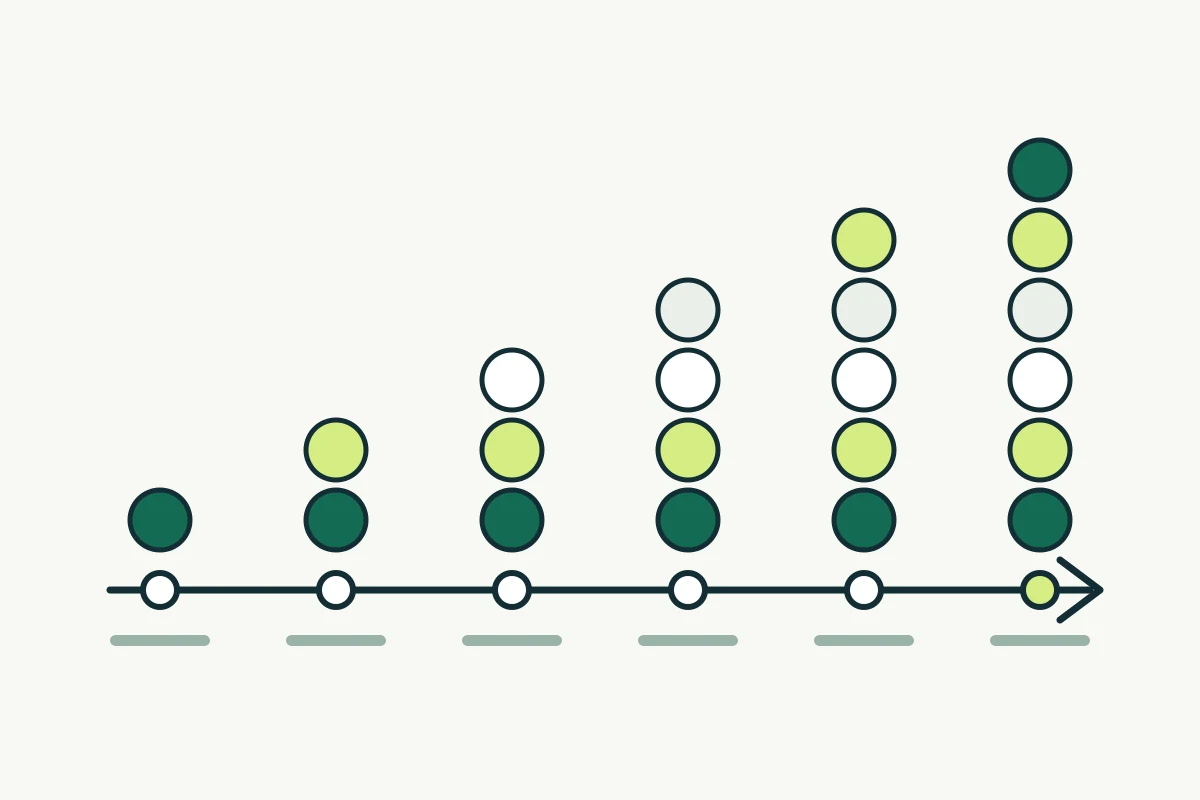
The B2B buying process has six stages in Gartner's model, the one most guides follow: problem identification, solution exploration, requirements building, supplier selection, validation and consensus creation. Each stage is a job the group must finish before it can move on, and as Growth Method's summary of the framework notes, buyers often revisit an earlier stage rather than move in a straight line.
- Problem identification: someone inside the company recognises a problem or opportunity, often after a change such as a missed target or a new rule.
- Solution exploration: the group learns which kinds of solution exist and researches them independently.
- Requirements building: the group writes down its must-haves, such as features, integrations, security and budget.
- Supplier selection: a shortlist is compared against those requirements. CXL reports that 78% of the B2B buyers in a 2024 Wynter survey shortlisted only three vendors for demos.
- Validation: references, trials, security checks and pricing are tested to reduce risk.
- Consensus creation: the champion wins agreement from everyone who can say no. Growth Method calls this the most overlooked stage.
The list says what buyers are doing. It does not say who is doing it, and that is what most of this guide covers.
Why do guides disagree on five, six, seven or eight stages?
Guides split or merge the same moves, so the stage count changes while the underlying process does not. The table lines up the main models as of November 2026.
| Model (page date) | Stages | How it differs from Gartner's six |
|---|---|---|
| Gartner, as summarised by Growth Method (22 Jun 2026) | 6 | The baseline used in this guide |
| SOCO Selling (updated 15 Apr 2026) | 5: recognising a problem, commitment to change, investigating and comparing, RFP, choosing a supplier | Adds commitment to change and the request for proposal (RFP); has no consensus stage |
| Highspot (updated 28 Sep 2026) | 3: awareness, consideration, decision | Merges the four middle stages into one |
| JA Consulting (Apr 2023) | 7: awareness, education, recognition of needs, consideration, evaluation, decision, delivery | Splits early learning in two and adds post-purchase delivery |
| OpenStax marketing textbook | 8: problem recognition, need description, product specification, supplier search, proposal solicitation, supplier selection, order-routine specification, performance review | Adds contract terms and a post-purchase review |
| Consensus (23 Sep 2025) | 12 steps, from an internal champion advocating change to implementation | Frames the process as repeated internal conflict and agreement |
Pick one model and keep it. This guide uses Gartner's six because it names the buying jobs without assuming a fixed order, and because it ends at the decision, which is where a supplier's content stops being useful. Gartner's own page was not readable when we checked, so the stage names here come from the Growth Method and Shopify summaries of it.
Who Is in the B2B Buying Committee, and How Many People Is That?
A B2B buying committee is the group of people who research, assess and approve one purchase, usually drawn from several departments. Sources disagree on its size because they count different things.
| Source | Figure | What it counts |
|---|---|---|
| Gartner, via Shopify (7 Apr 2025) and Growth Method (22 Jun 2026) | 6 to 10 people | Decision-makers in an average B2B purchase |
| Gartner, via CXL (updated 4 Feb 2026) | 5 to 11 stakeholders from 5 business functions | Members of a buying group |
| Wynter research on B2B SaaS marketing leaders, via CXL | A median of 5 decision-makers | Survey answers from 100 executives at companies with 200 or more staff |
| JA Consulting (Apr 2023) | About 12 | No source given |
| Highspot (updated 28 Sep 2026) | A dozen or more C-level and manager-level stakeholders | No source given in the article |
Plan for the roles, not the headcount, because the number moves with deal size and with what the author counted. Our B2B buying group guide explains the counting differences and treats buying group, buying committee and decision-making unit as near-synonyms.
Shopify names five committee roles: the initiator who spots the problem, the influencers who shape opinion, the decision maker who approves spend, the buyer who handles terms, and the end user. CXL's example committee is more practical for content planning: a department head, an IT director, a finance manager, end users, and legal and procurement. Our buying group guide has a six-role table with a page type for each.
Which Buying Committee Role Joins at Which Stage?
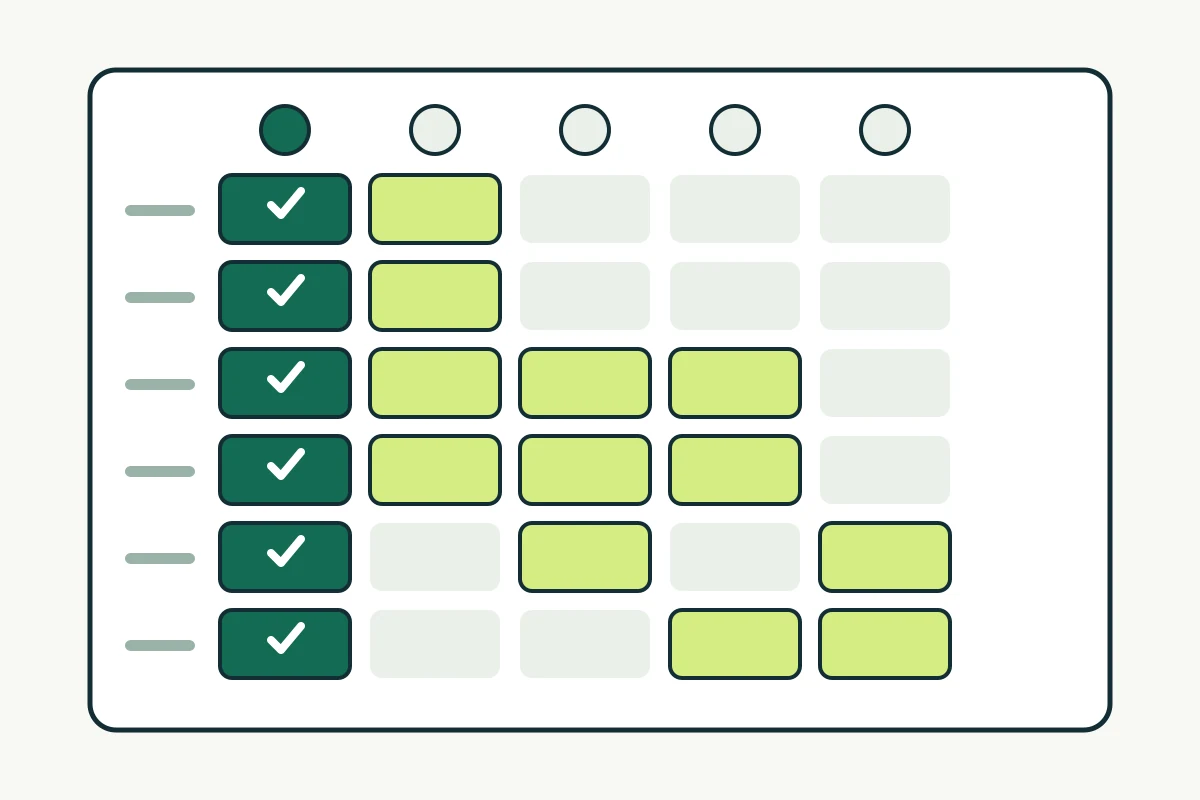
Committee roles do not arrive together. The champion usually starts alone, and the technical evaluator, finance, procurement, legal and executive sponsor join as requirements, risk and cost become real. The table maps each Gartner stage to the roles most active in it and the page that should answer them.
This table is our working model, assembled from the stage descriptions in Growth Method, Consensus, Highspot and CXL. It is not measured data, so check it against your own closed-won and closed-lost deals before you build on it.
| Stage | Roles most active | What they need to settle | Page that should exist |
|---|---|---|---|
| 1. Problem identification | Champion, end users who feel the pain | Is the problem real and worth fixing? | A problem-led guide the champion can forward |
| 2. Solution exploration | Champion, influencers (department heads, outside experts) | Which kinds of solution exist? | A category explainer and a comparison of approaches |
| 3. Requirements building | Technical evaluator (IT), end users, finance setting a budget range | Must-haves, integrations, security, budget | A requirements checklist, an RFP template, integration documentation |
| 4. Supplier selection | The whole group; the economic buyer scans price | Who is on the shortlist, and why | Pricing, comparison pages, case studies, a demo path |
| 5. Validation | Technical evaluator, procurement and legal | Risk: references, security, contract terms | A security and compliance page, terms, customer references |
| 6. Consensus creation | Executive sponsor, economic buyer, champion | Can everyone agree, and will it pay back? | An ROI explainer and a business-case template |
Early stages: the champion and the influencers
The champion carries the whole case alone at first. Consensus describes this person as often not in a leadership role, frequently a lower-level employee investigating options, so the most useful early content is something they can forward to colleagues without a sales call. Growth Method adds that SEO and organic content matter most here, because the searches are about the problem rather than any supplier. A query such as "why do contract approvals take so long" is an illustration of the type, not a measured search.
Influencers join as the group names its options. They are department heads inside the company or outside voices such as analysts and peers, and they judge whether the category makes sense before anyone compares suppliers.
Middle stages: technical evaluators, end users and finance
CXL lists the questions that dominate shortlisting: can you solve our specific problem, how does it integrate with our tech stack, what is the real pricing and total cost, how customisable is it, and what security and compliance features are included. Each question belongs to a different role, so one generic features page cannot answer them all. Growth Method pairs this stage with comparison guides, feature checklists and RFP templates at requirements building, then reviews, case studies and demos at supplier selection.
The website carries most of the weight. CXL reports that between 97% and 100% of surveyed buyers examine a vendor's website before a sales call, and the article gives both figures.
Late stages: procurement, legal and the executive sponsor
Late joiners ask for proof, not persuasion. CXL's final-evaluation questions are ROI from similar implementations, support when things go wrong, compliance (SOC 2, GDPR, HIPAA), how long the supplier has been in business, and whether it will scale. Growth Method places security questionnaires, compliance documents, references and contract negotiation at validation, and says marketing should make that stage frictionless.
Finance often holds the final say. Highspot says the CFO usually has final decision-making power in buying groups that include VP-level staff or above. Consensus-stage content such as an ROI calculator or business-case template, which Growth Method recommends, gives the champion something to put in front of that person.
Where Do Buyers Search, and Where Does SEO Fit in the Buying Process?
For recent samples of B2B software buyers, search is mostly a verification step, not the first step, but it still shapes the shortlist. CXL's summary of a 2025 Wynter survey of 100 B2B SaaS marketing leaders found three habits in sequence: peer-led discovery (72%), review-led validation on sites such as G2 and Capterra (54%), then search-led verification on Google (51%). The same article reports that 88% of buyers arrive at a sales call already familiar with the vendor, and that 24% of the chief marketing officers surveyed used AI tools such as ChatGPT or Perplexity in buying decisions.
A second survey points the same way for AI tools. Our guide to how AI search changed B2B buying summarises a 2026 Semrush survey of 622 US B2B professionals, 519 of whom used AI for work. Of those AI users, 72% used it in early research, yet 75% still used Google or another search engine for vendor research and 71% visited the vendor's website after an AI mention. Both samples are small and US-led, so read them as direction, not UK data.
The sources disagree on where search sits. Growth Method says SEO matters most at problem identification, while CXL says Google comes after peers and reviews have named the vendors. Both can be true because different stages use different queries: problem and category searches come early, and brand, pricing, "vs" and review searches come late. Gartner's figures, as quoted by Growth Method, show why content has to work without a rep: buyers spend 17% of their journey meeting potential suppliers and 27% researching independently online, and 75% say they prefer a rep-free experience. Our B2B SEO strategy covers how to plan pages for both ends.
Why Does a B2B Purchase Stall Between Stages?
A purchase stalls when the group cannot agree, not when it cannot find a supplier. Highspot cites Forrester's 2024 State of Business Buying report for the figure that 86% of B2B purchases stall during the buying process. Gartner, via Growth Method, reports that 77% of buyers describe their latest purchase as very complex or difficult, and Consensus says internal conflict returns once costs are discussed, citing CEB research that group conflict peaks 37% of the way through.
Three stall points are worth checking on your own site:
- The champion has nothing to forward. The pages that win agreement at stage 6 are the ones nobody wrote.
- A late joiner finds no answer. Procurement or security opens the site at validation and cannot find terms, compliance detail or references. Our guide to B2B buying groups calls this the shadow veto.
- The website and the sales rep disagree. CXL reports Gartner's finding that buyers are 2.8 times more likely to close a high-quality deal when rep and website messaging is consistent.
Our sales and SEO alignment guide shows how to turn stalled deals into content briefs.
How Do You Audit Your Content Against the B2B Buying Process?
Audit it as a grid of stages and roles, and treat every empty cell as a content gap. The method below extends the role-to-query mapping in our buying group marketing guide by adding when each role first appears.
- Fix the model. Use the six Gartner stages and no other, so every page and every deal note uses the same labels.
- Record the stage each role joined. Open your CRM for the last ten won and ten lost deals. For each opportunity, note the role and the stage at which that person first appeared.
- Fill the grid. Put roles across and stages down, then write the URL of the page that answers each cell. A blank cell is a gap, and two URLs in one cell is a cannibalisation risk.
- Check the pages in Search Console. Confirm that early-stage pages attract problem queries and late-stage pages attract brand and comparison queries. A mismatch means the page is serving the wrong stage.
- Rank the gaps by stalled deals. Ask sales which role joined late in lost deals and what they asked. Brief the three biggest gaps first, using our content brief guide and the B2B keyword research method.
A role is not a buyer persona. A persona describes a type of person across many accounts, while a committee role describes the job someone does in one purchase, and a finance director can be the economic buyer in one deal and absent from the next. Use roles for the audit because they map to stages, and keep personas for tone.
If you want a second pair of eyes on the grid, request our free 20-minute B2B SEO audit.