
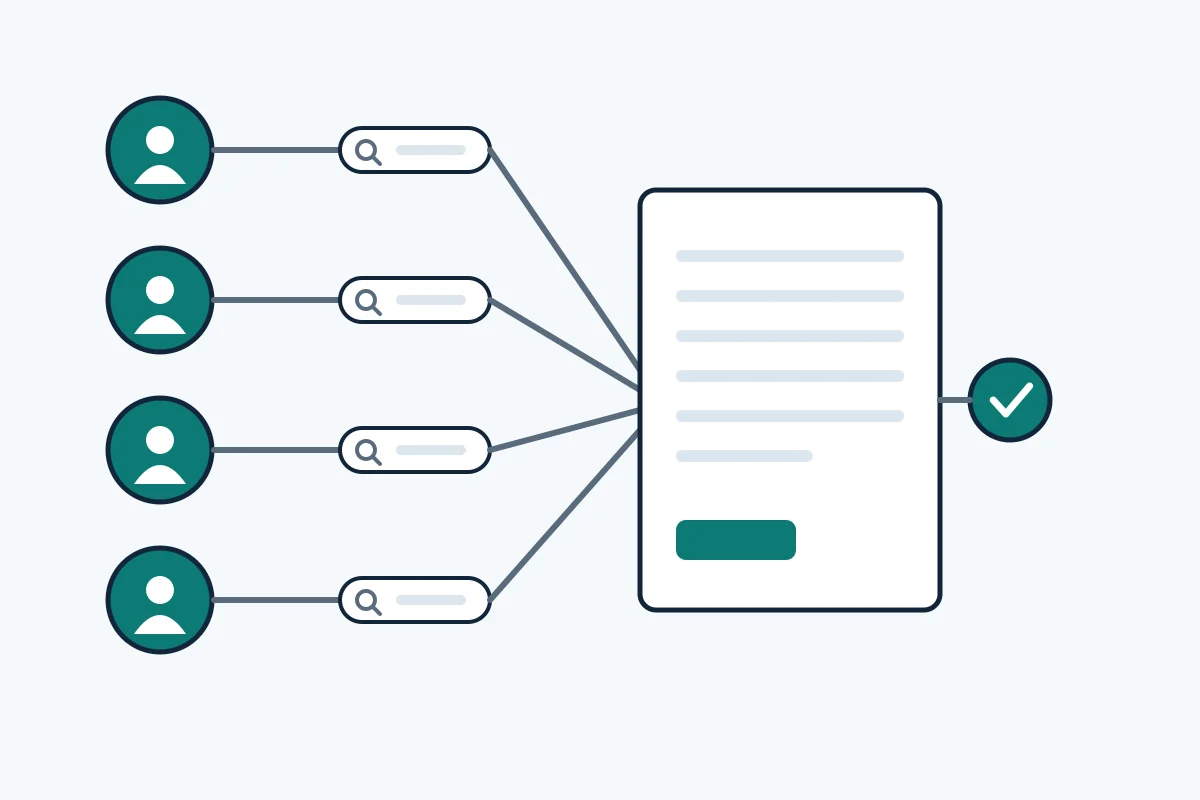
What is B2B buying group marketing?
B2B buying group marketing plans messages, content and measurement around everyone involved in one business purchase, not around a single contact. Marketing academics call the group the buying centre, which Wikipedia defines as "all those members of an organization who become involved in the buying process for a particular product or service". Robinson, Farris and Wind developed the concept in 1967. Sales teams usually say buying committee, and the terms mean the same thing in practice.
Account-based marketing (ABM) chooses which companies to pursue. Buying group marketing works one level down: it decides which person inside those companies needs which answer. For search, the output is a map from each role to the queries it types and the one page that should answer each. Our post on why B2B buyers do not convert like consumers covers the roles and the conversion problem, and ABM and SEO covers choosing the accounts. This post covers the search mapping.
Why does SEO need to plan for the whole buying group?
SEO has to plan for the whole group because the people who approve a purchase research it separately, and any one of them can end the deal. Forrester's 2021 analysis found that a group of three or more made the decision 84% of the time on solutions costing more than $5,000, and 38% of sellers in its revenue-operations survey sold to groups of 10 or more. Published averages vary: 6sense research cited by Search Engine Journal puts the group at about 11 people, and Intentsify's research at about 13. The counts differ partly because buyers, Forrester notes, "tend to count people they think were influential, not everyone who was involved."
Suppliers see little of this research. Gartner's 2020 research, cited by Intentsify, found that buyers spend about 17% of their buying time with potential suppliers. Forrester's State of Business Buying 2024, also cited by Intentsify, found that 86% of purchases stall at some point. A page that answers only the champion's question leaves the finance, technical and legal questions to other sources.
Why do buying jobs matter more than funnel stages?
Buying jobs matter more because Gartner describes buying as a set of jobs that do not happen in sequence, so a single funnel stage cannot describe where a searcher is. As summarised by Intentsify, the four jobs are problem identification, solution exploration, requirements building and supplier selection. Other summaries of Gartner's research add validation and consensus creation.
Stakeholders move between these jobs as new people join the group. A query therefore belongs to a job as well as a role. A finance reader asking about price is doing supplier selection, and the same reader asking what problem the product solves is back at problem identification.
How do you map buying group roles to search queries?
Map them in five steps, working from your own deals before you open a keyword tool. The method combines the persona-to-keyword mapping described by LATT/SEO with Gartner's buying jobs.
- List the roles from won and lost deals. Open the CRM and note which job titles joined each recent deal and when. LATT/SEO also advises interviewing three to five sales reps, then holding five to ten customer conversations about what people searched when they began evaluating.
- Reduce the roles to two to four query personas. LATT/SEO recommends two to four personas for keyword mapping and merging roles that share queries, formats and criteria. Prospeo suggests starting with three to five roles, and its mid-market default is champion, economic buyer, technical validator, user and procurement.
- Attach a buying job to each role. Ask which job each role is doing when it searches. Intentsify lists ROI, payback and total cost as the economic owner's concerns, and data handling and service levels as the concerns of IT, security and legal. Those concerns point to supplier selection and requirements building.
- Write the query each role would type. Use the wording buyers use on sales calls, not tool suggestions. LATT/SEO's examples: an engineer searches for a chemical compatibility chart, procurement for supplier lead times, and an operations VP for downtime reduction. Judge each query on fit before volume; LATT/SEO contrasts 50 monthly searches from the right decision-stage persona with 5,000 from students.
- Give each query one page and one primary role. LATT/SEO's keyword map has seven columns: keyword, monthly search volume, buyer persona, buying stage, intent type, target page URL and content format. Then audit the existing pages for missing stages, roles with no page, and pages that try to serve two roles. Our B2B SEO strategy uses the same one-term-one-page rule.
What does a role-to-query map look like?
A role-to-query map is a table in which every row holds one role, one buying job, one query and one page. The table below is an illustration for a fictional supplier of e-signature software. The queries are examples written for this post, not measured searches, and no search volumes are claimed.
| Role | Buying job | Example query | Page that should answer it |
|---|---|---|---|
| Champion (operations manager) | Problem identification | contracts taking too long to sign | Problem guide with a cost-of-delay example |
| Champion (operations manager) | Solution exploration | e-signature vs manual approval for contracts | Category explainer with a comparison |
| Technical evaluator (IT) | Requirements building | e-signature software SSO and audit trail requirements | Security and integrations page |
| Economic buyer (finance) | Supplier selection | e-signature software pricing per user | Pricing page with a payback explanation |
| Procurement | Supplier selection | e-signature provider data processing agreement | Terms and data processing page |
| End user | Validation | how to send a contract for signature | How-it-works walkthrough |
Read the table by row. Each query has one role, one job and one page, so no two pages compete for the same question. The champion appears twice because the same person does two different jobs and needs two different pages. A row with no page is the next brief to write; our guide to SEO content briefs for B2B shows what to put in it.
Treat the map as a working document. Prospeo recommends reviewing roles quarterly because roles and influence shift, and LATT/SEO says at least annually. The B2B keyword research method shows how to score each query before it earns a row.
How do you keep content consistent across the group?
Write each page for its role, but make every page tell the same story, because the group has to agree before it buys. Intentsify cites 2025 Gartner research finding that 74% of buying teams experience unhealthy conflict, and that teams that reach consensus are 2.5 times more likely to call the outcome high quality. Pages that give finance one price, IT another scope and procurement different terms add to that conflict.
Three habits keep the pages aligned. Use the same claims, numbers and terms on every role page. Give the champion pages that read well when forwarded, because suppliers get only about 17% of buying time and the champion does much of the selling inside the company. Keep one summary or comparison page that every role can read.
How do you check that every role reaches the page?
Check it with three sources, because no single tool shows both the query and the role. LATT/SEO's method is to compare Search Console impressions by landing page with the queries you expected for each role, then tag leads in the CRM by entry page and confirm the job titles match. If engineering content produces marketing-manager leads, revisit the mapping.
| Source | What it can show | What it cannot show |
|---|---|---|
| Search Console | Queries and pages that earned impressions and clicks | Who the searcher was, or their role |
| CRM entry-page tag | Which page a lead entered on, and the lead's job title | People in the group who never filled in a form |
| Sales calls | The questions and objections people actually raise | How many searchers ask the same question |
Account-level signals need more than Search Console. Intentsify's consensus-health measure counts whether finance, security, legal and the sponsor are active in the same 14-day window, which depends on account-level tooling. A site without it can count the CRM contacts attached to each opportunity and compare won and stalled deals. Our guides to sales and SEO alignment and measuring B2B SEO ROI cover how to feed those findings back.
What mistakes weaken a role-to-query map?
Most mistakes come from building the map without evidence or letting it age. LATT/SEO and Prospeo name these five:
- Building personas from assumptions. Sales calls, CRM records and customer conversations should supply the roles and queries, not a workshop guess.
- Treating the map as fixed. Roles and influence change, so schedule the review.
- Ignoring influencers. Some people research on behalf of the approver and never appear as the decision maker.
- Optimising for volume over fit. A few searches from the right role beat thousands from the wrong audience.
- Writing for individuals instead of the group. Prospeo warns that separate tailored messages can leave stakeholders with conflicting understandings before internal meetings.
Where should a small B2B team start?
Start with the one service that brings the most enquiries and build a table of two to four roles for it. Take the roles from recent won deals, write each role's queries, assign one page to each query, and add roles only when the win and loss data shows a gap. Prospeo advises that under a $30K deal size, reaching several people matters more than a large persona framework.
To see which roles on your site have no page, book a free B2B SEO audit. The audit checks the pages you have against the questions each member of the group asks.