
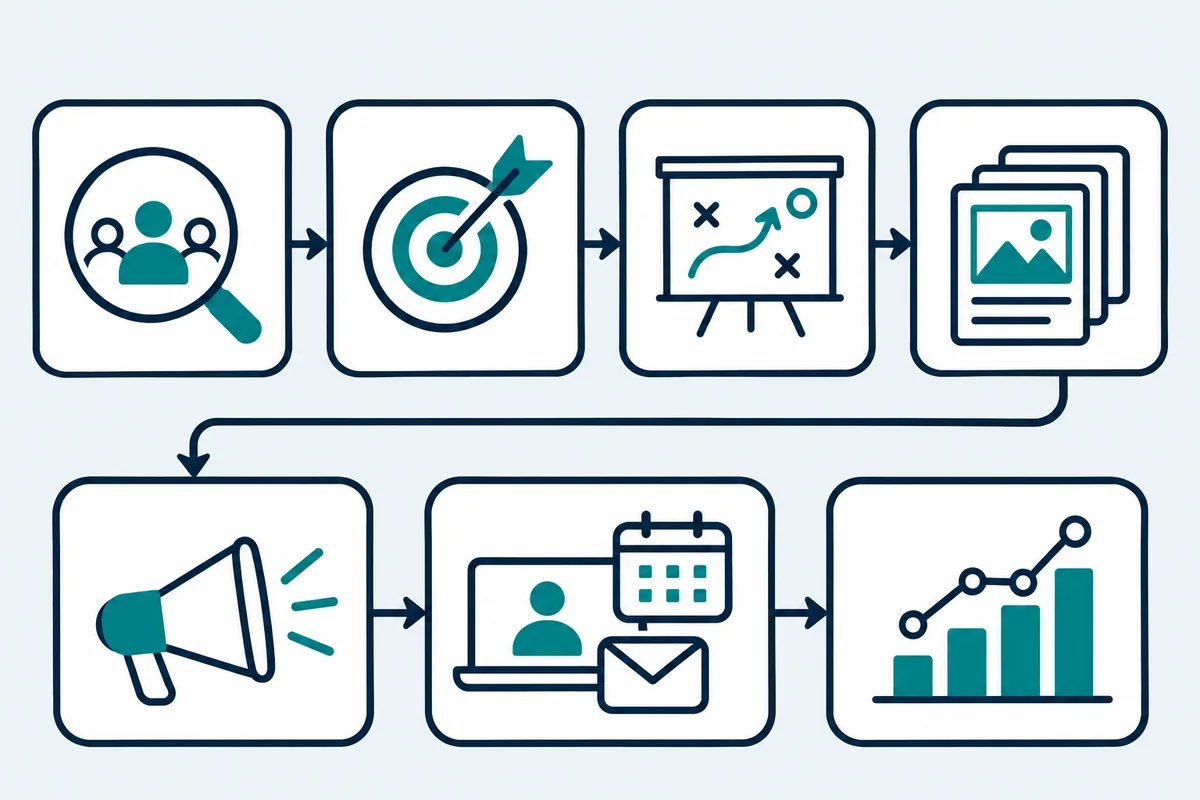
Publishing more articles is not a strategy. A plan has to say who each piece helps, what decision it supports, who can verify its claims and how a buyer will encounter it. This seven-step framework is designed for UK teams that need a plan they can run with limited time and specialist input.
What should a B2B content marketing strategy achieve?
It should help suitable buyers make a decision and give the sales team evidence they can use. Choose a commercial outcome before you choose a content format. That might be more qualified enquiries for a service, more opportunities from a target sector, or fewer deals stalled by the same technical objection.
Set a baseline in your CRM and analytics: enquiries, qualified opportunities, pipeline and the pages people visited before contact. Search Console can show which queries expose those pages; it cannot tell you whether an account bought. Give each page a primary job and a secondary measure. For example, a comparison page may help a shortlist decision, with engaged target accounts as an early signal and opportunities as the later result.
Step 1: Which buyers and buying group roles are you serving?
Start with recent won, lost and stalled opportunities. Ask sales what the first contact wanted, who joined later and which objection was hardest to answer. Group the people by the job they perform in the purchase, rather than inventing a separate persona for every title.
A champion may need a short case they can forward. A technical evaluator needs integration and security detail. Finance needs price, contract terms and an explanation of value. An end user wants to see the workflow. Forrester describes champions, decision makers, influencers, users and ratifiers as distinct roles in a B2B buying group; one person can play several roles in a small firm. Use the buying group guide to map their questions to pages.
Write a one-page audience brief: target accounts, excluded accounts, buying trigger, roles, questions, objections and evidence available. Mark assumptions clearly. A sales interview is a better start than a persona generated from job titles alone.
Step 2: How do you audit existing content and search demand?
List every page that already answers a target buyer question. Record its URL, owner, search query, intended role, last meaningful review, and next action: keep, update, combine or retire. Look for two pages competing for the same query before adding a third.
Use Search Console for real query and page data. Use keyword tools to estimate demand, but do not reject a specialist query just because its reported volume is small. Add phrases from sales calls, support tickets, proposal questions and product demos. B2B keyword research explains how to separate problem, solution, comparison and supplier searches.
Make a gap list after the audit. If finance repeatedly asks about cost and the site hides every price clue, that gap may matter more than another broad awareness post. Keep a source column so every new brief can cite the person or data behind its proposed claim.
Step 3: How should you choose topic clusters and page jobs?
Give one page ownership of each main search intent. A topic cluster groups those pages around one commercial subject. A service page should explain the offer and make the next step clear. A supporting guide can explain the problem, method or buying criteria and link to that service page. A comparison page can help a buyer distinguish options without pretending every option fits everyone.
Start with two or three clusters tied to services you can actually deliver. Within each cluster, plan a core page, proof pages and supporting answers. For example, a B2B SEO cluster could include a service page, a definition, a buyer's guide, a case study and a measurement guide. The content marketing service page should own the commercial query, while this article owns the planning question.
Do not use the same keyword as the purpose of several URLs. If two drafts answer the same question for the same reader, combine them or give one a narrower job. This is why the calendar calls for consolidation before more publishing.
Step 4: What belongs in each content brief?
Every brief needs a reader, a decision, a question and a claim the page must prove. Add the target query, the existing page it supports, the required source material, internal links, a useful next step and the person who can verify technical details.
Interview the subject matter expert before writing. Ask for a real example, common failure, exception and evidence that a competitor summary would miss. Google recommends original information and substantial added value in helpful content. A page built only from paraphrased search results has little reason to earn a buyer's trust.
Use one direct answer near the top, then explain how the answer works. Make tables and checklists only when they help a reader compare or act. State what you do not know. A UK buyer should be able to distinguish a local price, a US benchmark and an estimate without searching the footnotes.
Step 5: How do you set an editorial workflow a small team can keep?
Assign an owner to each handoff: brief, expert interview, draft, fact check, legal or compliance review where needed, final edit, publication and refresh. Put the owner and due date in the calendar. A missed expert review should move the publication date, not quietly remove the review.
Start with a pace the team can sustain. Two useful pieces a month can outperform a crowded calendar of interchangeable posts if those pieces solve buying problems and get distributed. Record the version and date of facts that change, such as prices, product features and regulations. Put a review date beside them.
Before publication, test all links, the title and description, heading order, mobile readability, page speed and the next action. Then ask someone who did not write the piece: what decision can you make after reading it? If the answer is unclear, revise the page.
Step 6: Where should you distribute B2B content?
Plan distribution when you approve the brief. Search can bring a new buyer to an answer, but many buying group members will meet the page through a colleague, a sales email, a partner or a professional community. Give the sales team a one-sentence reason to share each page and the objection it answers.
Send a concise version to relevant email subscribers. Adapt the insight for LinkedIn without copying the whole article into a post. Ask partners to share only where it genuinely helps their audience. Link from the core service page and from sibling guides so readers can move from research to evaluation. Avoid gating the basic answer a buying group needs to circulate internally.
Track distribution by channel and by the accounts it reaches where your tools allow it. A social impression is an exposure, not proof of a sales result.
Step 7: How do you measure and improve the plan?
Review performance at page and cluster level. Search Console shows impressions, clicks and queries; analytics shows page behaviour and enquiries; the CRM shows whether those enquiries became qualified opportunities and revenue. None of these tools alone can explain the whole B2B purchase.
Hold a monthly review with sales. Ask which pages they sent, which objections remain unanswered and whether target accounts are progressing. Refresh pages with stale facts, weak answers or poor conversion paths. Combine overlapping pages when both compete for the same intent. Keep a note of each change so later results have context.
Use the B2B SEO ROI guide to connect organic activity to pipeline without claiming every deal came from its first search visit.
What does a workable 90-day plan look like?
The first month is for evidence: agree the business goal, interview sales, inspect the CRM and audit existing pages. In the second month, choose the first cluster, brief its highest-value gaps, interview experts and update the core page. In the third month, publish supporting pages, distribute them through sales and owned channels, and review early signals. The time periods are a planning example, not a promise of search results.
| Period | Deliverable | Decision gate |
|---|---|---|
| Days 1–30 | Buyer brief, content audit, baseline report | Is the target account and page gap clear? |
| Days 31–60 | Cluster map, expert briefs, updated core page | Can a buyer verify the main claims? |
| Days 61–90 | Supporting pages, distribution log, first review | Did the right accounts and questions reach the pages? |
If the first review shows traffic from the wrong audience, change the page's query and framing. If the right buyers arrive but still ask an unanswered question, add the missing evidence. See how our content service works if you need help building the first cluster.